Bricks and Mortar or Investment Value?
If there is one question we are asked more than any other by HMO investors, it is this: will the lender value my property on an investment basis, or as bricks and mortar?
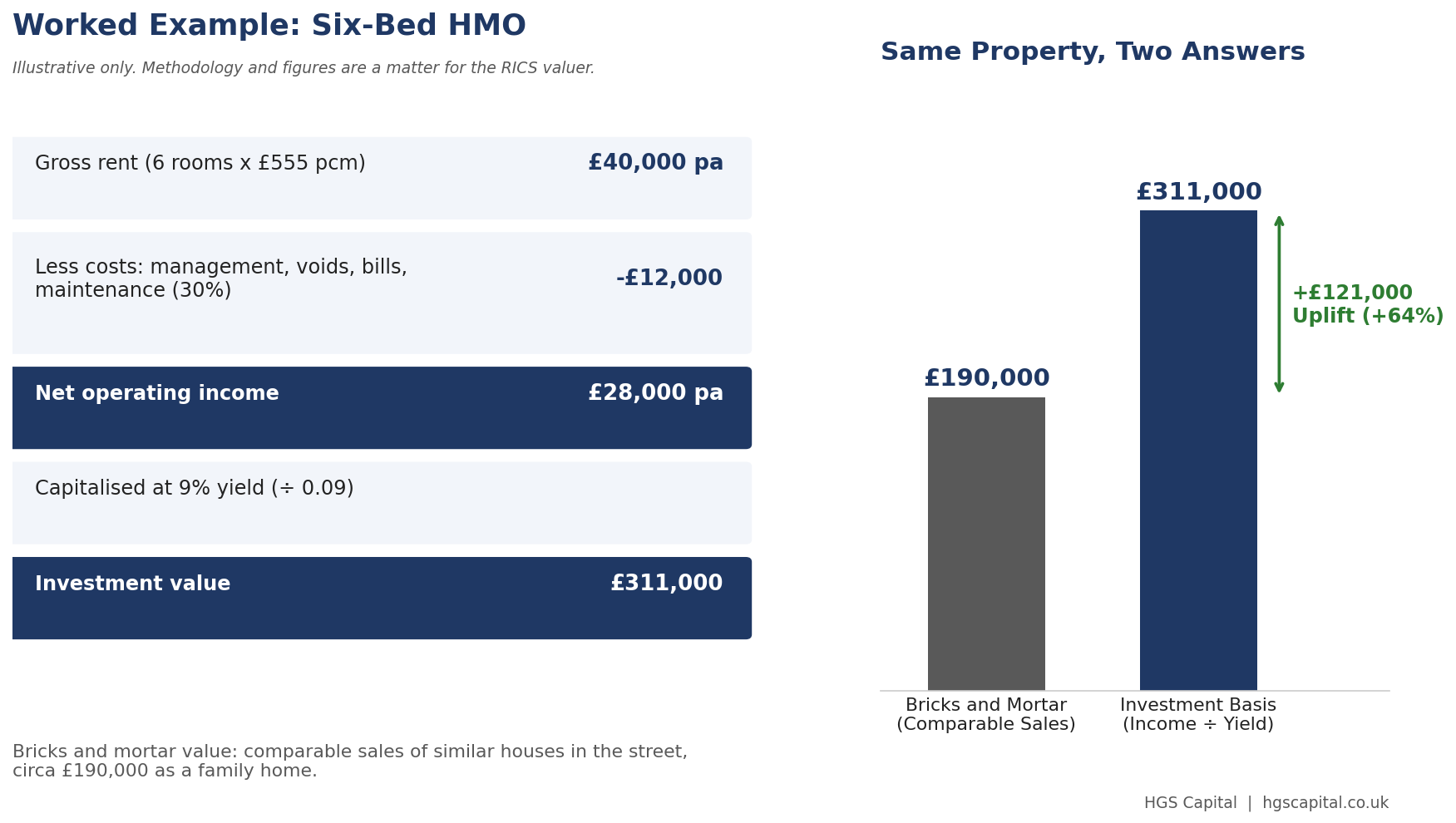
It is an important question to ask, because for the same property the two answers can be a long way apart. In areas where purchase prices may be modest but room rents are strong, an investment valuation can come out vastly higher than the value of the building as a single family home. That difference determines how much you can borrow, how much capital you can release on refinance, and whether your deal works at all.
Valuation methodology
A bricks and mortar valuation, properly called the market or comparable approach, values the property by reference to sold prices of similar houses nearby. It is how most homes are valued and it takes little or no account of the rental income the property generates as an HMO.
An investment valuation instead capitalises the property’s rental income at a yield derived from local market evidence. In simple terms, the valuer takes a realistic annual rent, deducts appropriate allowances for costs such as management, voids and bills, and divides the resulting income by an appropriate yield. Where a HMO produces a strong rental income, that income stream can support a value well above what the house would fetch as a standard family home on the same street.
Who decides which methodology applies?
Not the broker, and not the borrower. The valuation is carried out by a RICS registered valuer, who will exercise their independent professional judgement in line with the RICS professional standards and the lender’s own instructions. That independence matters and no credible broker should try to interfere with it. What a good broker does is make sure the case is put to the right lender, on the right basis, with the right information in front of the valuer, so the property has a fair chance of being assessed on its merits.
When an investment valuation is realistic
The RICS standard is clear that methodology follows the evidence, but certain features point strongly towards an investment approach:
• Larger HMOs with more than six occupants, which sit in their own sui generis planning use class and are treated predominantly on an investment basis.
• Properties in areas covered by an Article 4 direction, where new HMOs need planning permission. Scarcity of consented stock can support a premium over surrounding family homes.
• Properties that have been genuinely altered and adapted for multiple occupation, such as en-suite rooms, additional bathrooms and fire compliance works, so they are no longer directly comparable with neighbouring houses.
• Locations with real transactional evidence of HMOs selling to investors on a yield basis, rather than reverting to owner occupation.
Conversely, a lightly converted small HMO in a street of owner-occupied houses, with no Article 4 restriction and no evidence of investor sales, is unlikely to attract a premium. As the RICS standard puts it, an investor could simply buy the house next door and convert it, so the market will not pay significantly more for yours.
Where the broker earns their keep
Lender selection is the single biggest factor within your control. Lenders differ widely in when they will instruct a valuation on an investment basis, which valuation panels they use, and how they treat sui generis and Article 4 properties. Placing a genuinely converted eight-bed HMO with a lender that only values on a bricks and mortar basis leaves money on the table. Placing a lightly converted four-bed with a lender expecting a commercial valuation wastes a valuation fee and everyone’s time.
Our approach at HGS Capital is to establish the realistic valuation basis and lender appetite first, before any valuation is instructed, so clients are not committing to fees on a hope. We present the property’s planning position, licensing, works undertaken, tenancy schedule and income evidence properly, and let the valuer reach their own conclusion from a well-prepared file. That is the legitimate way to get the most out of your property, and in my experience it is also the most effective one.
A word of caution
Investment valuations are sensitive instruments and the RICS standard warns valuers to treat aggressive appraisals with care. A valuation built on unrealistically high rents will not survive scrutiny, and a yield assumption just one percentage point out can move the value by well over 10 per cent. Rents must be sustainable market rents, not figures inflated by temporary demand, and the valuer will deduct realistic allowances for management, voids, bills and maintenance before capitalising. If a sourcing agent has sold you a deal on the promise of a guaranteed commercial valuation, be sceptical. Nobody can guarantee that.
Talk to us
If you are buying, refinancing or converting an HMO and want an honest view on how it is likely to be valued and which lenders fit, get in touch. HGS Capital arranges business-purpose property finance for landlords and investors across England and Wales.